ST. BARNABAS, TWON-BRASS: The Church That Refused To Die – From The Memoirs of Late Chief Samuel D. Eke-Spiff, J.P., OON (1868 – 2003)
By Timeless Persons | Source: The Memoirs of Late Chief Samuel D. Eke-Spiff, J.P., OON
Editor’s Note: If you have not yet read it, please first read the biography of Late Chief Samuel D. Eke-Spiff, J.P., OON, already published here on Timeless Persons Blog.
That biography tells you who the man was.
This history tells you what he did for God and for Twon-Brass.
All facts, dates, names, and thoughts in this history are from his own memoirs – written in his own hand, and completed with his own money.
When he wrote of St. Barnabas, Twon-Brass, he was not writing as an outsider. He was writing as the chief benefactor who gave N8,500 at the beginning, and later committed around N10 million to complete and furnish the present St. Barnabas Church, dedicated on 8th November, 2003.
This is his legacy in stone.
There are men who write history. And there are men who make history, then write it so that their children will not forget.
Late Chief Samuel D. Eke-Spiff, J.P., OON, was both.
Without his memoirs, we would not know the full story of St. Barnabas Anglican Church, Twon-Brass. Without his immense contributions, we would not have the present St. Barnabas Church standing today.
This is his story, as he told it. This is the story of his church.
- The Beginning: 20th August, 1868
As recorded by Chief Eke-Spiff, it was Bishop Samuel Ajayi Crowther, under the auspices of the Church Missionary Society (CMS), who established a mission at Twon-Brass in 1868.
On the same date, 20th August, 1868, both church and school were established simultaneously. Seventy persons attended the opening service. Seventeen students were enrolled.
The early work was superintended by Messrs J.P. Cowing and S.S. Paddy, then resident at Akassa, who came to Twon alternately every fortnight. They were later relieved by Mr. (later Reverend) Thomas Johnson as permanent superintendent.
Rev. Thomas Johnson served for almost sixteen years. He died on 11th April, 1884 and was buried in the mission yard at Twon-Brass.
Bishop Crowther later commented, as Chief Eke-Spiff faithfully recorded:
“What a change has taken place at Brass River within the short space of 12 months. Who hath despised the day of small things, especially when the beginning of such small thing originated with the Lord of the Vineyard Himself…”
- From Bamboo To Iron: The First Buildings
Initially, the church was built of bamboo poles and thatch. Later, on the same spot, a wooden structure was erected, covered with galvanized iron sheets.
That building was dedicated by Bishop Crowther on 21st October, 1869, with Chiefs Samuel Sambo and Fred Pepple (popularly known as Okoloba Ishikiri) among the congregation. The Bishop preached from St. Matthew 12:29. A mission house was also erected, part of which served as classroom. An average of fifty persons attended Sundays.
Chief Eke-Spiff notes with pride that Chief Samuel Sambo and Chief Thomas Ada Spiff not only supported the church financially but also served as wardens for a number of years in spite of their exalted positions.
- The Enlargement of 1875 – 1877
In 1875, it became necessary to enlarge the chapel. Donations were invited.
- Chief Samuel Sambo donated £20 in gold sovereign for an English pulpit.
- Chief Fred Pepple from Bonny gave £10 for a reading desk.
- Chief Ada Spiff bought a brass bell for £18, an harmonium for £15, and a chancel chair for £6.
The inscription on the bell still reads: “Presented by Chief Thomas Spiff to St. Barnabas’ Church, 1877”. The bell cracked after some years, was sent to England for recasting, and all expenses were borne by Ada House.
It was during the dedication of the enlarged chapel in November, 1877 that the name “St. Barnabas” was given to the church.
- The Iron Church: 1886 – A People’s Miracle
In 1886, the Twon Community decided to import a pre-fabricated iron church from England, similar in design to the one at Opobo.
The materials arrived with the “SS Lagos” on 7th March, 1886. The foundation was laid on 31st March. Archdeacon D.C. Crowther deposited in the foundation a bottle containing a brief history of the church from 1868 to 1885, copies of Common Prayer in Nembe language and Hymns.
Erection commenced on 1st April, 1886 and by August, the church was ready.
The church with fittings cost £1,201 : 12 : 2d. Chief Samuel Sambo alone contributed £480 (including £200 paid later) and Ada House presented £200 in the name of Chief Thomas Ada Spiff who had died some years earlier.
Chief Eke-Spiff records the most touching incident:
When the cost had been remitted to England there was an unexpected delay. Chief Samuel Sambo was told that £200 was still outstanding, and without consulting the community nor even his fellow chiefs, Chief Sambo collected £200 in gold sovereign from his safe, went to the mission alone and delivered the money to the Pastor.
The socks in which the amount was delivered was kept at the mission for many years as evidence of what an individual can do for his God and his Community.
- The Dedication: 10th October, 1886
The dedication took place on Sunday, 10th October, 1886 at 11 a.m., attended by 565 persons. Bishop Crowther preached from Isaiah 49:22-23. Forty-five candidates were confirmed.
Special gifts were received from C. de Cardi, Esq., Messrs Strides of Dover, England, Mr. J. Barness, Chief Samuel Sambo (a striking Wall Clock, still in use), Chief James Spiff (brass communion rails), and George Sagbengo Esq. (pulpit frontal and communion kneeling stools).
The evening service at 6.30 p.m. was attended by 469 persons. Collections amounted to £9:3:6d in cash, 10 pieces of madras cloth, 24 fathom cloth, 16 reels of thread, 13 heads of tobacco and pipes.
On 17th October, 1886, the first ordination was held when Samuel Peters was ordained priest by Bishop Crowther, assisted by Reverends J. Boyle, J.D. Garrick and Archdeacon Crowther. The charge was: “Be thou faithful unto death and I will give you a crown of life” – Revelation 2:10.
- The Complete List of Clergymen Who Served At Twon (1868 – 2003)
As preserved in Appendix IV of Chief Eke-Spiff’s memoirs:
No. Name Years Served
1 Rev. Thomas Johnson 1868 – 1884
2 J.D. Garrick 1884 – 1886
3 Samuel Peters 1886 – 1888
4 Aaron C. Williams 1886 – 1890
5 P.J. Williams 1890 – 1892
6 N.T. Hamlyn 1893 – 1896
7 Henry Proctor 1897 – 1902
8 J.C. Wilson 1903 – 1906
9 Richard Taylor 1906 – 1909
10 Frank Wilber 1909 – 1912
11 S.S. Williams 1913 – 1917
12 M.D. Showers 1918 – 1921
13 A.A.D. Spiff 1922 – 1924
14 D.O. Ockiya 1924 – 1928
15 J.C. Kalama 1929 – 1932
16 Elliot S. Bens 1929 – 1932
17 C.O. Olorunfoba 1953 – few months
18 Ven. Archdeacon J.E. Ouama 1960 – 1964 (retired)
19 Rev. Canon J.K.O. Ibiayemie 1965 – 1969
20 “Dan” 1990 (one yr.)
21 Canon M. Jumbo 1991 – 1993
22 Canon M. Abibo 1991 – 1993
23 Canon A.I. Kune 1994 – 1995
24 Canon E.A. Iyaye 1995 – 1996
25 T.A. Lasbury 1997 – 1999
26 Can. M.S. Oaji 2000 – date
These were the men who held the fort. Some died there. Some retired there. All left their footprints.
Chief Eke-Spiff also records in Appendix III the long list of men ordained from the mission – including J.O. Ockiya, D.O. Ockiya, S.P. Ockiya, A.A.D. Spiff, J.O. Kalama, M.D. Lala, M.H. Kalama, Dandeson C. Spiff, O.I. Banigo, O.T. Ockiya, Christopher Ockiya, S.P. Ogboma, S.P. Biaman, I.A. Ockiya, O.S. Fiebika, A.H. Hanga, Blana Igene, H.A. Igene, F.R.A. Igene, P.H. Famah, O.H. Igbikuma, J.A. Etebu, P.V. Etebu, J.I. Osei, and E.H.A. Igene.
- The Dark Years: Pastorate Crisis, Erosion and Desertion
The church suffered a severe setback following the inauguration of the Niger Delta Pastorate under Rev. (later Bishop) James Johnson on 29th April, 1892. All churches in the Niger Delta except Brass and Abonnema joined the Pastorate.
Brass and Abonnema were persuaded to remain loyal to the CMS on the promise that the Society would help them regain markets taken by the Royal Niger Company. The Society failed. This led to mass exodus, especially at Nembe before and after the Akassa War in 1895.
Relief only came with the merging of the Pastorate churches with the CMS following the consecration of James Johnson as Assistant Bishop of the Niger Delta on 18th February, 1900.
But worse came. The imported iron church, threatened by erosion, was dismantled in 1927 and its materials dumped at the new mission site to suffer decay.
In 1934, the headquarters of the Brass Church District, which had been at Twon since 1868, was moved to Nembe. The resident pastor was transferred. The District Office closed. The Union Jack flag post was dismantled. Commercial establishments closed due to the global economic depression.
As Chief Eke-Spiff wrote: It was “the deepest humiliation, socially, spiritually and economically, Twon has ever faced in her life.”
For over forty years, only catechists were sent. Twon was moving into spiritual hopelessness.
- The Revival of 1937
In November, 1937, a high-power Revival Mission of about ten clergymen spent a week in Twon holding prayers and open air services.
On the Sunday before their departure, Rev. S.S. Williams delivered a powerful, emotion-laden sermon that moved the whole congregation to tears.
Within a few months, the District Office was re-opened. Life improved. But true spiritual re-awakening waited until Rev. C.O. Olorunfoba was posted in January, 1980.
- The Rebirth And The Man Who Paid The Price: Chief Samuel D. Eke-Spiff
This is where the memoirs become personal. This is where Chief Eke-Spiff stops being just a writer and becomes the builder.
With Rev. Olorunfoba, Chief Eke-Spiff records, it brightened “as if the battery has been re-charged by divine forces.”
Steps were taken to excise Twon and surrounding churches from Nembe and reconstitute them into a separate District comprising Twon, Ewoama, Okpoama, Odioma, Fanuo, Eliwema, Liama and Beletiema. The new district was solemnly inaugurated by His Lordship Bishop S.O. Elenwo on Sunday, 16th May, 1982.
Rev. Olorunfoba spent five eventful years as superintendent. During that time, a modern parsonage was built at a cost of N24,000, equipped with furniture, to serve as rallying point.
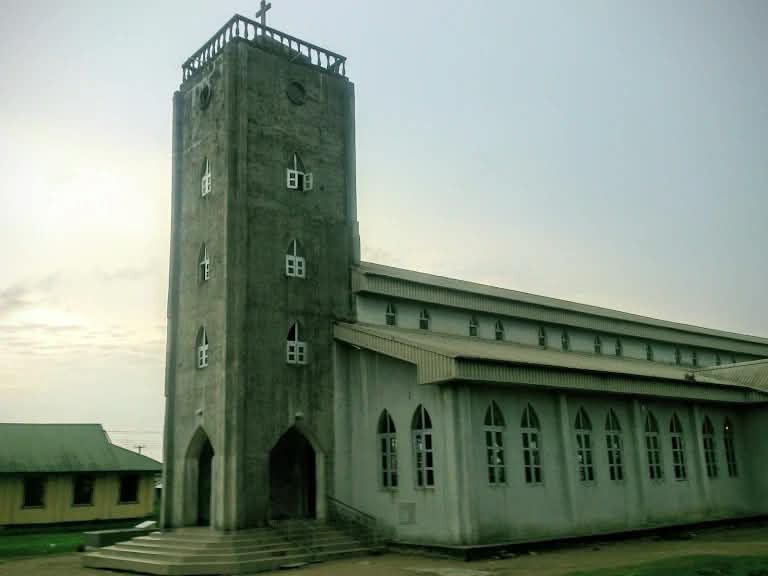
Then came the gigantic stride: building a befitting church to reflect the eminent position of Twon as the second station on the onward march of Christianity in the Niger Delta.
At a meeting of the entire congregation on Easter Sunday in 1984, at which all the chiefs were present, the majority voted in favour of a befitting edifice.
The foundation was laid on 13th February, 1985 under the direction of Archdeacon J.E. Ouama (retired).
Because of the nature of the soil, the building was elevated four feet above ground level. It required about 200 tipper loads of sand. At N300 per tipper, it would have cost N60,000, but Nigerian Agip Oil Company offered their tipper free of charge and the committee only paid N4,000. As Chief Eke-Spiff wrote, it was as if by divine direction.
And then, Chief Eke-Spiff gave.
Of the initial effort so far received, Chief Eke-Spiff records in his own hand: the sum of N8,500.00 was donated by the writer as his initial expression of his sincere gratitude to God for manifold blessings.
The foundation stone for a new Church building was laid in mid 1986. But construction lingered for seventeen years. Lack of finance was a major factor. Some, Chief Eke-Spiff wrote painfully, not only failed to support but actually pulled strings in influential circles to forestall the laudable effort.
But God moves in a mysterious way.
Construction resumed at accelerated speed, and the Author, Chief Samuel D. Eke-Spiff, did not hesitate to commit around N10 million towards the completion and furnishing of the edifice, fit for Twon-Brass and worthy of God.
N10 million. In his lifetime. From his own resources. For his God and his Community.
That is why the present St. Barnabas Church stands today. Not by government. Not by oil company. But by the faith and generosity of a son of Twon-Brass who remembered what his fathers had done in 1868, in 1877, in 1886 – and decided that his generation would not be the one to let the light die.
- The Dedication: 8th – 9th November, 2003
The Church was formally dedicated by the Bishop of the Niger Delta West Diocese, Adolphus Amabebe on Saturday 8th November, 2003. A thanksgiving service was held on Sunday 9th November, 2003.
Both services were colourful and richly attended by Ministers of God and dignitaries from Lagos, Port Harcourt, Yenagoa and sister churches. The Bishop enjoined praise for those who worked assiduously, and had the same measure for those who worked against the project.
Chief Eke-Spiff had lived to see it. He had lived to see the promise fulfilled.
- The Men Who Fell At Their Posts
Among the intrepid missionaries – Europeans, West Indians and Sierra Leoneans – was Captain Frederick Mellor Leigh-Lyle, not a missionary but a great friend of the church. He was District Officer for Brass Division and died after visiting Nembe with his wife on 3rd December, 1915.
On 5th December, 1915, Reverend S.S. Williams delivered a sermon so touching that the Anglican Mission had to print it in full:
“We have been called together this afternoon by that which is common to every man, and which moves with an impartial foot both within the palaces of kings as well as in the humble cottages of the poor: and that is ‘Death'”
A befitting marble monument was erected by his dear wife over his grave.
- The Legacy
As Chief Eke-Spiff concluded in his memoirs:
Christianity has brought light to those in darkness, hope to the down-trodden and freedom to the mentally imprisoned. Barbaric customs such as human sacrifice and killing of twins have become a thing of the past. Permanent structures now adorn the skyline in defiance of the gods that forbade durable materials.
The first Parochial Committee, inaugurated on Saturday, 25th February, 1908 under Venerable Archdeacon D.C. Crowther, with members including Chief James A. Spiff, Clarkson Teknikio, Dandeson C. Spiff, Caleb Inyanamuka, Abel Nwingia, George Spiff, and P.D. Kirison as secretary, laid the foundation for lay leadership.
Chief Eke-Spiff’s final belief, as written in his memoirs, remains our charge today:
“Christianity is a religion of challenges based largely on faith, and that wherever there is a move of God Satan is ever ready to offer opposition. At the end the Great Architect of the Universe always triumphs.”
Twon-Brass did not just build a church. Through Chief Samuel Sambo in 1886, through Chief Thomas Ada Spiff, and through Late Chief Samuel D. Eke-Spiff, J.P., OON, in 2003, it built a testimony that one man, when he gives to God, can change the destiny of his community.
May his soul rest in perfect peace. May his memoirs never die.
His life made this church possible. His memoirs made this history possible.