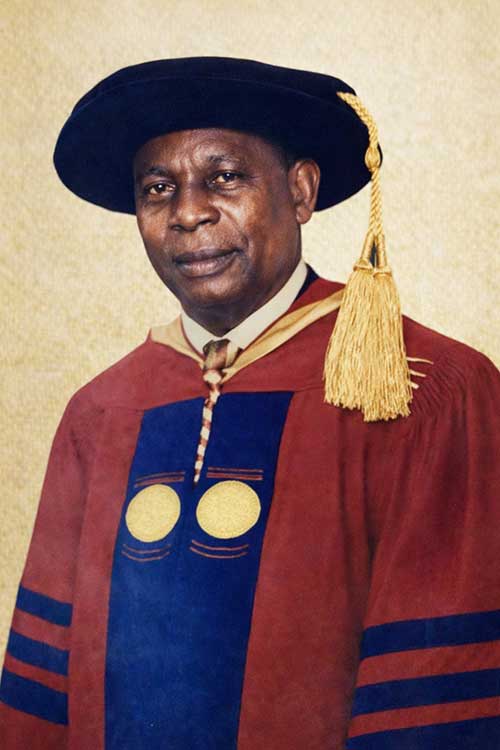
Eze Ogba Nwadei Ogbahi — The Man Who Walked Away From Power on Principle
Born: October 4, 1927 — Omoku, Ogba/Egbema/Ndoni LGA, Rivers State
Died: Late 2016
Residence: 13A, Forces Avenue, GRA, Port Harcourt, Rivers State
Hometown: Omoku, Rivers State
There are men who seek power. And there are men who, when power demands they betray their conscience, walk away from it.
Senator Francis John Ellah belonged to the second — and rarer — breed.
He was a polished technocrat, a British-trained administrator per excellence, a politician with no double standard, and a man whose sincerity became his signature. In a country where politics is often about horse-trading, lobbying, and survival, Ellah chose principle over seat, honour over comfort, and truth over tenure.
That single choice — his resignation from the Nigerian Senate in 1981 — made him timeless.
The Making of a Technocrat
Francis John Ellah was born on October 4, 1927, in Omoku, into the Umuenyike Royal Family. His father was Chief Isaiah Ellah.
His education reads like the journey of a generation that built Nigeria:
St. John’s School, Onitsha; St. John’s School, Imo River; St. Mary’s and St. Michael’s, Omoku; Christ the King School, Aba (1936-42); Holy Family College, Abak; St. Patrick’s College, Ikot Ansa, Calabar (1943-46).
He then entered University College, Ibadan (now University of Ibadan) from 1948-51, as part of its pioneer class, and later the Graduate School of Public Administration, New York University, 1960-61.
He did not just go to school. He was schooled for service.
A Civil Servant Who Served Everywhere
Ellah’s career in public service is one of the most complete in Nigerian history. He rose through every rung — teacher, clerk, District Officer, diplomat, Permanent Secretary, Registrar, Secretary to Government.
He taught at Ibibio State College, Holy Family College Abak, Oriwu College Ikorodu, and Oduduwa College Ile-Ife.
He served as Assistant District Officer in Afikpo, Ikot Ekpene, Arochukwu and Umuahia (1955-58), District Officer, Orlu Division (1958-59).
He represented Nigeria abroad as Second Secretary, Nigerian Embassy, Washington D.C. (1959-60), Officer in Charge of Nigerian Students in the USA, New York (1960), and First Secretary for Economic and Finance Matters, Washington D.C. (1961).
Back home, he was Divisional Officer, Enyong; Protocol Officer, Premier’s Office, Enugu; Higher Assistant Secretary, Ministry of Internal Affairs; Senior Divisional Officer, Aba (1963-66); Deputy Permanent Secretary in Commerce, Military Governor’s Office, and Local Government in Enugu (1966-67).
During the Civil War years, he was Special Representative, London Office (1967-68), Administrative Head, Ministry of Transport and Communication, Eastern Nigeria (1968-69), and Secretary, Atrocities Commission (1969-70).
After the war, Rivers State claimed him: Permanent Secretary, Ministry of Information and Local Government (1970-71), Registrar, College of Science and Technology, Port Harcourt — now Rivers State University (1971-75), and finally Secretary to the Military Government and Head of Civil Service, Rivers State (1975-78).
Across Rivers political history, he is remembered simply as: District Commissioner, Registrar of RSUST, Secretary to Government, Minister.
He was a man who knew how government worked — because he had built it with his own hands.
The Industrialist Who Looked Beyond Oil
When many of his peers retired into politics alone, Ellah built industry.
As Chairman of Chief J.W. Ellah Sons and Company Limited, and Chairman of Ellah Lakes (Fish Farms) Limited since 1978, he founded one of the earliest large-scale commercial fish farms in Nigeria.
Ellah Lakes, based in Omoku, became a model for aquaculture in a region addicted to oil. It created jobs, fed people, and proved that the Niger Delta could produce, not just extract.
It still operates today — a living testimony to his vision.
The Senator and The Unfinished Motion
In 1979, Ellah was elected Senator of the Federal Republic of Nigeria under the Nigeria People’s Party (NPP), representing Rivers State.
In the Senate, he brought a motion for the creation of additional states to correct federal imbalance, give minorities a fair voice, and address the structural injustice in Nigeria’s federation.
The Senate President ruled the motion out of order. It was declared “The Unfinished Motion.”
For most politicians, that would have been the end of the matter. They would have lobbied, horse-traded, waited for another day.
Ellah did the unthinkable: He resigned voluntarily on principle in 1981.
His resignation rendered the then Senatorial District — comprising the old Ahoada and Ikwerre — vacant till the end of that dispensation. It was a sacrifice that shocked the nation.
He later explained himself in his classic book, The Unfinished Motion (1982), followed by Nigeria and States Creation (1983) with a preface by Chinua Achebe. Some called the book “medicine after death.” But history has proved him right: Nigeria’s debate on restructuring, state creation, and federal balance is still unfinished today.
Ellah understood what many never learn: Legislative business is not just lobbying. Sometimes, it is standing alone for what is right, even when you lose the vote.
The Cultural Bridge Builder
Though an Ogba man from Rivers, Ellah consistently identified with his Igbo heritage. He was a founding father and former Secretary-General of Ohanaeze Ndigbo, and remained active in the organisation till death.
It was a bold identity in a divided region — a statement that culture is not confined by state boundaries.
In 1998, he offered himself again as a Presidential Aspirant under the Peoples Democratic Party (PDP).
Honours, Faith and Family
He was Knight of the Order of St. Gregory the Great (KSG), a Papal Honour in 1976. He received Doctor of Laws (LLD) from University of Port Harcourt (1990) and Rivers State University of Science and Technology (1991). He was Fellow, Institute of Directors, UK/Nigeria.
He married Patricia Ireju Obowu in 1956, from the Obowu clan of Omoku. They had three sons.
He was traditionally titled Eze Ogba Nwadei Ogbahi — Eze Nwadei of Ogbaland.
Writer and Historian
Ellah was not just a man of action; he was a man of the pen:
- Rural Development Handbook (1966)
- The Unfinished Motion (1982)
- Nigeria and States Creation (1983)
- Nigerian Society and Governance (1988)
- Ah Ogba — A History of the Ogba People (1995)
In Ah Ogba, he gave his people their history in their own voice.
Final Years, Residence and Death
Despite his national stature, Ellah remained deeply rooted. His home was at 13A, Forces Avenue, GRA, Port Harcourt — a quiet, respected address in the heart of Rivers State’s elite district, where he lived with his wife, Patricia Ireju Obowu, and received visitors, scholars, and politicians who came to seek counsel.
His official address was 13B, Forces Avenue, same GRA. From that residence, he continued to write, mentor, and serve Ohanaeze Ndigbo and his Ogba people till his final days.
Senator (Chief) Sir Francis John Ellah died in late 2016.
His passing was felt across Rivers State, the Niger Delta, and the Igbo nation. He was mourned not just as a former Senator, but as a father, a technocrat, and a moral compass.
In honour of his life, the Sir Francis Ellah Annual Memorial Lecture was instituted at the Federal College of Education (Technical), Omoku, beginning on his birthday, October 4, 2016 — and it has continued every year since.
He was buried as he lived: with dignity, with honour, and with the respect of a man who never sold his conscience.
Legacy: The Most Outstanding Ogba Man
Today, he is widely regarded as the most outstanding Ogba man in modern politics and public service.
But his true legacy is not in buildings or books. It is in character.
Francis John Ellah was a good man. A polished technocrat. A politician with all sincerity. A British gentleman per excellence, who displayed no double standard in all his dealings.
In an age when many have become enemies of truth because corruption is paying their bills, Ellah reminds us that a man can walk away from power — and still remain powerful forever.
He finished his race in 2016. His motion remains unfinished. His name remains unforgettable.
Timeless indeed.